Categories
Enterprise AI

The Integration Nightmare: Why Connecting AI to Legacy Systems Kills Most Rollouts—and How to Avoid It

One of the deadliest yet most common killers of enterprise AI adoption is the integration nightmare. Organizations buy into powerful AI capabilities, excited about automation and insights, only to hit a wall when trying to connect those models to existing legacy systems—ERP, HCM, CRM, finance platforms, and more. Disconnected data flows, incompatible APIs, security restrictions, and months-long custom development turn ambitious projects into costly, delayed failures that never reach production.

Why Legacy Integration Remains the Silent Killer of AI Projects

Modern AI thrives on real-time, bidirectional access to accurate enterprise data. Legacy systems fight back with:

  • Outdated architectures — Rigid, batch-oriented systems that don’t support live data exchange.
  • Complex, brittle APIs — Custom connectors require specialized developers and constant maintenance.
  • Security & compliance friction — Strict controls block easy access while risking violations.
  • Vendor lock-in traps — Proprietary formats and limited documentation slow progress.
  • Resource drainTeams spend more time on plumbing than on delivering business value.

The fallout? AI stays siloed in shadow tools or spreadsheets, adoption collapses, budgets balloon, and executive support evaporates.

4 Smart Ways to Bypass the Integration Nightmare

  1. Choose Platforms Built for Enterprise Reality Prioritize no-code/low-code solutions designed specifically for legacy and modern system integration—no heavy custom coding required.
  2. Demand Bidirectional, Real-Time Connectivity Ensure AI can read from and write back to core systems instantly, keeping data synchronized without manual intervention or ETL pipelines.
  3. Start with Pre-Built Connectors Leverage ready-made integrations with popular platforms (UKG, Workday, Oracle, SAP, Salesforce, etc.) to skip months of development and accelerate proof-of-value.
  4. Keep Security & Governance Native Select tools that inherit your existing enterprise security model and compliance framework, so integration doesn’t introduce new risks.

CloudApper AI: The Integration-First Path to AI Success

CloudApper AI eliminates the legacy integration nightmare with its no-code platform. Create custom AI agents that train securely on your corporate data, connect bidirectionally in real time to major enterprise systems (UKG, Workday, Oracle, SAP, Salesforce, and more), and deploy intuitive drag-and-drop user experiences—all without ripping out infrastructure or hiring armies of developers. AI activates fast, data stays governed, and organizations achieve scalable adoption without the usual integration headaches.

Want the complete foundational roadmap? Read the original article for the full picture on rolling out AI: How to Roll Out Artificial Intelligence in Your Organization

Start connecting AI to your systems today: CloudApper AI Platform – Build & Integrate LLM with Enterprise Systems

Stop fighting legacy systems. Achieve seamless, secure AI integration and turn your existing tech stack into a competitive superpower—without the nightmare.
Categories
Enterprise AI

The Rise of AI Chatbots in Healthcare: Enhancing Patient Access, Adherence, and Overall Care Quality

Have you ever wondered how AI chatbots are making healthcare more accessible and effective by providing instant support, improving treatment adherence, and helping patients stay on top of their health plans?

In modern healthcare, patients increasingly demand convenient, on-demand access to information and services without long waits or rigid schedules. AI-powered chatbots meet this need by acting as always-available virtual assistants. They manage essential tasks such as answering common questions about symptoms, medications, or procedures; scheduling and rescheduling appointments; sending personalized reminders; verifying insurance details; explaining billing; and even collecting feedback after visits—all in natural, conversational language.

This round-the-clock accessibility significantly boosts patient access to care. No more being put on hold during business hours or waiting days for email replies. Patients get immediate, accurate responses tailored to their needs, often in multiple languages, which is especially valuable for underserved populations or those with mobility challenges. The convenience leads to more proactive health management, as patients feel empowered to seek guidance anytime, fostering a stronger connection with their providers.

A major advantage is improved adherence to care plans and treatment regimens. Chatbots deliver timely reminders for medications, follow-up tests, lifestyle changes, or upcoming appointments, helping patients stick to recommendations. Real-world examples show adherence rates climbing substantially—some implementations report figures as high as 97% for enrolled patients in structured care programs. By reducing forgetfulness and providing gentle, consistent nudges, chatbots support better chronic disease management, preventive care, and recovery processes, ultimately contributing to improved health outcomes and fewer complications.

These tools also play a key role in elevating overall care quality. By handling routine inquiries, chatbots free up clinical and administrative staff to focus on more complex, hands-on interactions where human expertise and empathy are essential. This not only enhances the patient experience through faster resolutions but also supports higher-quality consultations and personalized attention. Patients often report feeling more valued and heard, leading to increased satisfaction, trust, and loyalty to their healthcare providers.

The healthcare chatbots market continues to expand rapidly, with recent estimates placing the global size in the range of USD 300 million to over USD 1 billion (depending on scope and methodology), and projections indicating strong growth at CAGRs frequently between 20% and 24% in the coming years. This momentum stems from ongoing advancements in natural language processing, greater emphasis on digital health solutions, and the proven value in streamlining operations while prioritizing patient-centered care.

Getting started with an AI chatbot is simpler than ever using no-code platforms. The core steps include:

  1. Defining priorities — Target high-need areas such as symptom guidance, appointment handling, or post-visit support.
  2. Customizing with compliance — Fine-tune the AI for medical relevance and integrate robust HIPAA-compliant security measures.
  3. Incorporating knowledge — Feed in your facility’s specific information, guidelines, and resources for contextually accurate replies.
  4. Building engaging dialogues — Create user-friendly, empathetic conversation paths deployable across websites, apps, SMS, and social channels.
  5. Launching and connecting — Roll out quickly and link to existing systems like electronic health records for seamless functionality.

CloudApper Conversational AI Chatbot offers a ready-to-use, healthcare-optimized platform with collaborative specialized agents:

  • Patient Registration Agent — Guides smooth, conversational onboarding.
  • Appointment Management Agent — Facilitates effortless 24/7 scheduling, modifications, and reminders.
  • Billing Agent — Clarifies charges and payments promptly.
  • Insurance Verification Agent — Provides fast coverage information.
  • Patient Service Feedback Agent — Gathers actionable insights post-interaction.
  • Compliance Agent — Upholds essential regulatory standards.

With multi-channel support, high reliability, and personalized interactions, CloudApper helps improve access, boost adherence, enhance satisfaction, and deliver higher-quality care without overwhelming staff.

Ready to make healthcare more patient-friendly and efficient through intelligent automation?

For practical steps on implementation: How to Build an AI Chatbot for Healthcare Patient Engagement

See how CloudApper Conversational AI Chatbot drives better patient access, adherence, and care quality: Improve Patient Experience & Reduce Health Worker Burnout with Conversational AI

Categories
Enterprise AI

Chat-Based Knowledge Management: How an AI Chatbot Turns Enterprise Information into Instant, Conversational Answers

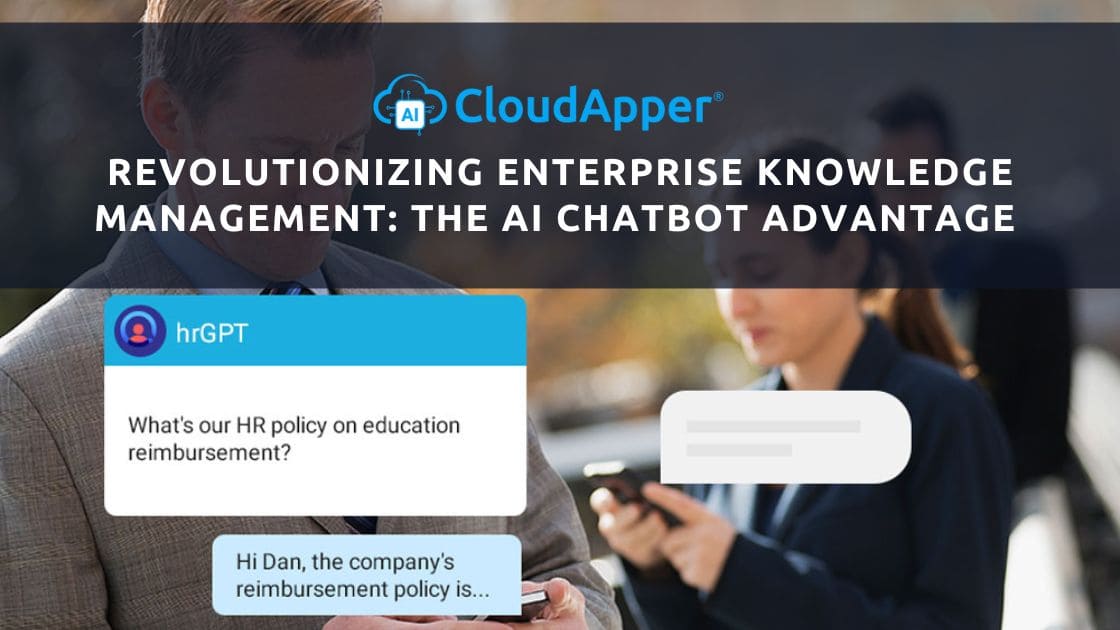
This teaser highlights the core value and benefits from the original CloudApper article. For the full technical overview, integration examples, security details, performance metrics, and how CloudApper implements true chat-based knowledge management, read the complete guide here: Revolutionizing Enterprise Knowledge Management: The AI Chatbot Advantage with CloudApper

In large organizations, knowledge is abundant — but access is painful. Employees spend hours searching across SharePoint, Confluence, internal wikis, HR portals, ticketing systems, Google Drive folders, and scattered emails just to answer routine questions. The result: wasted time, repeated support tickets, slow decisions, and frustration.

Chat-based knowledge management solves this by replacing fragmented search with a single, intelligent conversational interface. An AI chatbot becomes the natural gateway to your entire internal knowledge base — understanding natural questions, pulling precise context from multiple sources, and delivering accurate answers in seconds.

What effective chat-based knowledge management enables:

  • Natural-language queries (“What’s the current policy on remote work stipends?” “How do I approve a vendor invoice over $5,000?” “Show me the latest cybersecurity training checklist”) get instant, relevant responses
  • Real-time synchronization — policy updates in SharePoint or Confluence appear immediately in the chatbot
  • Contextual understanding — the bot remembers conversation history and role-based permissions to give tailored, secure answers
  • Mobile-first & multilingual delivery — frontline, shift-based, remote, and global teams get answers on their phones without switching apps
  • Self-service scale — 60–80% of routine internal queries handled without human intervention
  • Continuous refinement — usage analytics and feedback loops automatically improve answer quality over time

Organizations adopting chat-based knowledge management typically achieve:

  • Up to 70% reduction in time spent searching for internal information
  • Significant drop in help-desk and support tickets
  • Faster onboarding and knowledge transfer for new hires
  • Preservation of institutional expertise despite employee turnover
  • Elimination of knowledge silos across departments and tools

CloudApper’s chat-based knowledge management solution excels with deep integrations into common enterprise platforms, enterprise-grade security (data residency, encryption, role-based controls, GDPR/SOC 2/HIPAA compliance), and no-code setup that doesn’t require developers.

Want to explore the broader suite of enterprise AI capabilities — from chat-based knowledge to HR automation, workforce intelligence, and more? Check out the complete platform: CloudApper Enterprise AI Solutions

In today’s fast-moving businesses, the competitive edge goes to organizations where information flows freely and instantly through natural conversation — not buried in folders. Chat-based knowledge management powered by AI isn’t a future trend; it’s becoming essential infrastructure for modern enterprises.

Ready to replace slow searches and endless tickets with a smart, always-available chat interface that actually knows your organization?

Discover how CloudApper is leading with powerful chat-based knowledge management — read the full article here: Revolutionizing Enterprise Knowledge Management: The AI Chatbot Advantage with CloudApper

Categories
Enterprise AI

Conversational AI: Transforming Employee Onboarding into a Faster, More Engaging, and Personalized Experience

This teaser highlights the key concepts and benefits from the original CloudApper guide. For the complete details, real-world applications, integration insights, and implementation tips, read the full article here: Conversational AI for Employee Onboarding and Training

The first days on a new job are critical — yet traditional onboarding processes often overwhelm new hires with static documents, generic videos, long email threads, and slow responses to basic questions. This leads to confusion, reduced motivation, slower ramp-up, and a higher chance of early turnover.

Conversational AI completely redefines this experience by turning onboarding into a natural, interactive dialogue — like having a knowledgeable, always-available colleague guiding the new employee every step of the way.

With an intelligent chatbot at the center, new hires can:

  • Ask questions in plain language at any time (“How do I update my tax forms?” “What’s the process for expense reimbursement?” “When is my orientation session?”) and receive instant, accurate answers
  • Complete paperwork, policy acknowledgments, and compliance training through simple, guided chat flows
  • Receive short, role-specific training modules delivered exactly when they’re most relevant and at the right pace
  • Access everything on their mobile device — making it seamless for deskless, frontline, shift-based, remote, or global workers
  • Get support in multiple languages with gentle, automated reminders so nothing slips through
  • Provide real-time feedback during the process, allowing HR to refine and improve the experience continuously

The results are transformative:

  • Up to 50% faster time-to-productivity
  • Much higher engagement, completion rates, and satisfaction scores
  • Noticeably lower early turnover due to a welcoming and supportive first impression
  • Sharp reduction in HR support tickets during the onboarding phase
  • Stronger compliance and better long-term knowledge retention through interactive, contextual learning

CloudApper’s conversational AI integrates smoothly with your existing HR systems, delivering a branded, mobile-first experience that feels personal, modern, and genuinely helpful.

In today’s competitive talent market, where candidates expect digital-first, frictionless interactions from day one, conversational AI isn’t just an upgrade — it’s becoming a must-have for attracting, integrating, and retaining top talent.

Ready to replace overwhelming documents and delayed support with a conversational onboarding experience that actually delights new hires?

Discover how conversational AI is reshaping onboarding and training for modern workforces — read the full guide here: Conversational AI for Employee Onboarding and Training